
> archeologia
Archaeology at the Castle: glimpses of daily life
The origins of the Castelbuono Civic Museum are intertwined with the very history of the Ventimiglia Castle, the building in which the museum is housed.
The archaeology section presents the findings of the excavation campaigns carried out between 1996 and 1997, transforming the artefacts into tangible evidence of daily life.
Objects, traces and materials recount gestures, habits and presences: fragments that allow us to reconstruct the experiences of the communities that have inhabited these spaces over time.
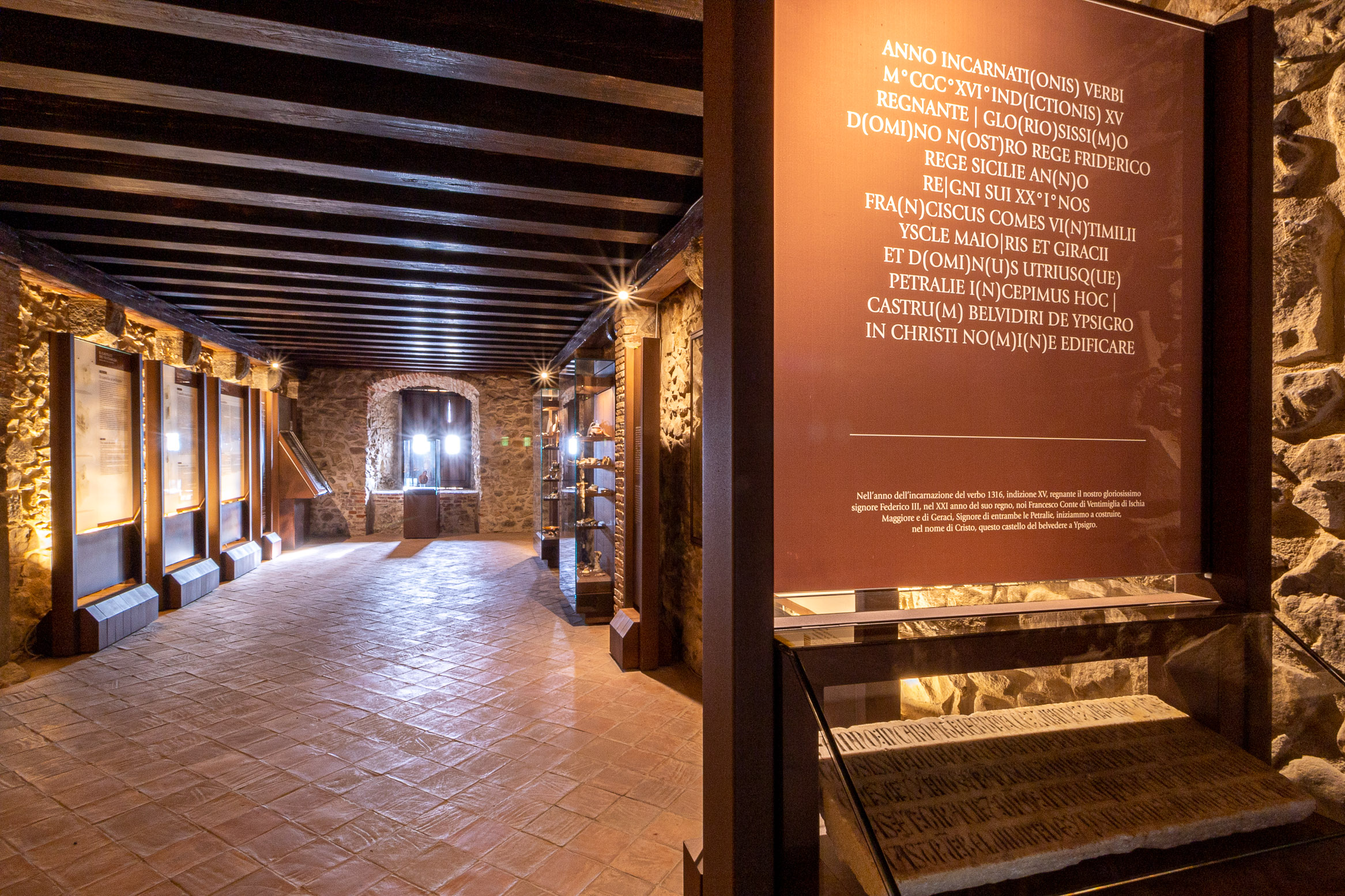
The Foundation Inscription (1317)
A marble slab. A date. The beginning of it all.
The inscription by Francesco I Ventimiglia is the most precious document in the archaeological section: it tells us with absolute precision when and why Castelbuono came into being.
A decision that changes everything
It is the year 1317. The Ventimiglia family, a powerful Norman dynasty ruling the entire County of the Madonie, made a decision destined to transform the territory forever: to abandon the rocky fortress of Geraci — impregnable, yet by now too isolated for the needs of a growing court — and to build a new residence on a hilltop that was more open, healthier, and better suited to controlling the territory.
The chosen site is the hill of San Pietro in Castelbuono. The project is not merely a fortress: it is a palace. A castle designed not only to defend, but to govern, represent and inhabit.
Thus was born the Castrum Bonum — the Good Castle — and with it the town that still bears that name today.
Why this inscription is extraordinary
In an era when written sources are rare and often imprecise, an inscription that definitively establishes a date of foundation is an exceptional document. Francesco I Ventimiglia’s inscription is not merely an artefact: it is the birth certificate of Castelbuono.
Before the Castle: the Tower and the ancient village of Ypsigro
The Ventimiglia Castle has roots that go back further than it seems. Before it became the stately residence we admire today, this hill already had a story to tell.
A cool place, already inhabited
The name says it all: Ypsigro means cool place. Even before the castle was founded, the hill was home to an ancient farmhouse of Byzantine origin — a living, inhabited settlement, deeply rooted in the Madonie region.
Watching over this village in the 12th century stood a watchtower: a simple yet sturdy structure, about 8 metres high, designed not only for warfare but also to monitor the surrounding countryside and harvests.
Watching over this village in the 12th century stood a watchtower: a simple yet sturdy structure, about 8 metres high, designed not only for warfare but also to monitor the surrounding countryside and harvests.
The detail that tells the story of an era
How did one enter? Only from the first floor, via a retractable ladder. In case of danger, one simply had to pull it up to remain safe inside. A simple yet ingenious system that reveals much about life — and fear — in those centuries.
From village to castle
Over time, the fortress grew around this first tower, later transformed into a palatial residence by the Ventimiglia family. A centuries-long evolution, from the Belvedere di Ypsigro to the Castrum Bonum, which the artefacts in the archaeological section recount item by item: pottery, tools, coins and stonework.
Silent traces of the daily life that unfolded here.
Daily life: between the kitchen and banquets
What did they eat at the castle? How did they cook? How were the halls lit after sunset? The artefacts from the archaeological section on display at the Castelbuono Civic Museum answer these questions with surprising concreteness — and bring us closer to the real lives of those who lived within these walls.
Dining with the Ventimiglia family
The jugs decorated with green and brown geometric patterns speak of the elegance of the Sicilian aristocratic table in the Middle Ages. But the most extraordinary artefact is a fourteenth-century fork.
An object we take for granted today was then an extremely rare luxury, accessible only to the aristocracy. The vast majority of people still ate with their hands or, at most, with a spoon. Holding that fork in one’s hand meant belonging to another world.
In the kitchen, amidst smoke and fire
Alongside the refinement of the table, the display cases preserve the tools of daily labour: the ceramic pots used every day for cooking. Many fragments still bear the marks of smoke and fire — concrete evidence that they were placed directly over the flames to prepare the meals served at noble banquets.
When darkness fell
Without electric light, life at Castelbuono Castle relied on small oil lamps now on display to the public. They were not merely decorative objects: they were indispensable tools that marked the rhythm of each day, making the halls and corridors habitable even at night.
A faint flame, yet capable of keeping the house alive.