
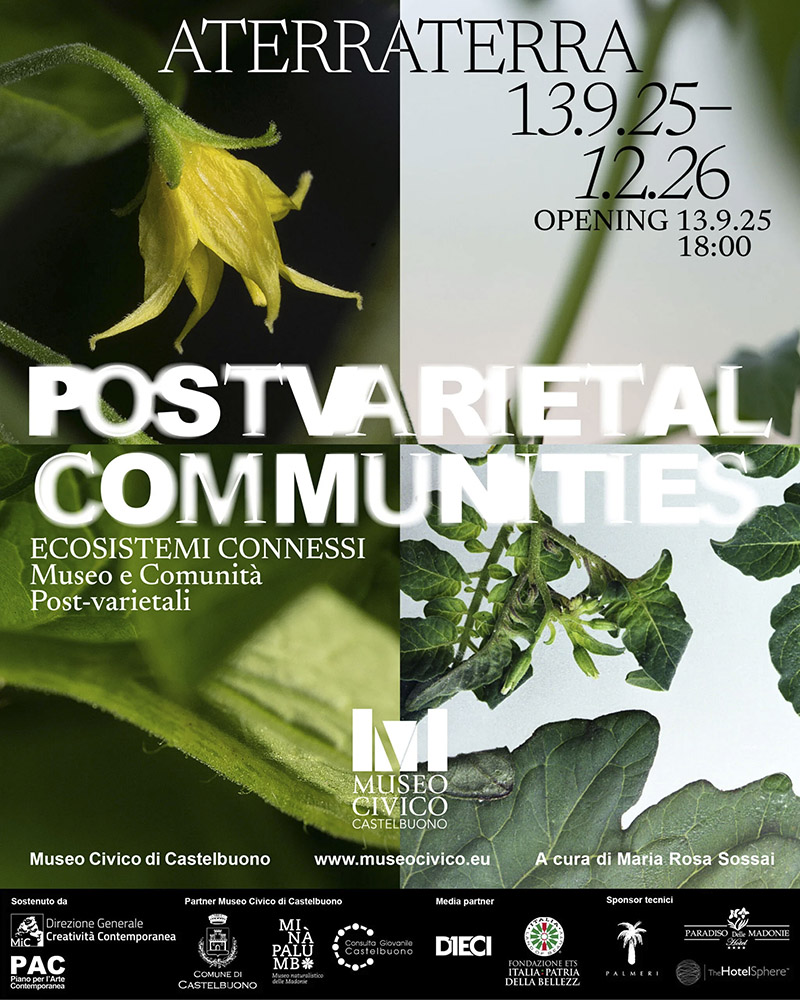
“Today we feel the need to transform the functions of the museum in light of the environmental urgencies that our historical moment imposes upon us, rethinking cultural production in ecological terms,” states Laura Barreca, Director of the Castelbuono Civic Museum. “Alongside the usual exhibition activities, there are participatory artistic initiatives aimed at fostering individual and collective responsibility towards the environment and the landscape, as parts of our heritage. The project E Connected Ecosystems. Museums and Post-Varietal Communities has become an ecological manifesto, an expression of the cultural direction pursued by the Museum, as part of a complex ecosystem not limited to the cultural context but closely intertwined with environmental dynamics: a fusion of museum, people, nature and contemporary creativity.”
The project
The project Connected Ecosystems has developed around the concepts of the ‘post-varietal community’ and the museum as an ecosystem, an experimental practice stemming from a series of reflections on the relationship between humans and cultivated plants. Through processes of uncontrolled and unpredictable hybridisation, post-varietal communities challenge forms of discipline and genetic control over plants, as well as established narratives surrounding the concepts of ‘nature’, ‘purity’ and ‘varietal fixity’.
In the spring of 2025, Aterraterra established a post-varietal tomato community by planting a mix of 25 different varieties of domesticated tomatoes and wild species, such as Solanum pimpinellifolium, an ancestor of tomatoes and an “ancestral” species predating domestication, which produces small edible fruits and still exists in the wild in South America. The wild species grown exhibit characteristics of resistance to drought and high temperatures, which have generally had an impact in Sicily, causing prolonged droughts and extreme temperatures. In collaboration with architect Elena Catalano, the artists have designed a wooden support system (toolkit downloadable here) for the plants to climb, conceived to encourage the process of cross-pollination.
In this ‘post-varietal community’, the process of random and uncontrolled hybridisation has created plants with ever-changing and unpredictable forms and characteristics that no longer possess the ‘purity’ of the original varieties, the result of human-guided practices of discipline and control.
The exhibition
In addition to the hybrid tomato community, the exhibition features a series of photographs and an audio installation in the castle tower. The photographs depict various aspects of the growth process of the post-varietal tomato community and their changing forms: morphological features such as leaves, flowers, growing fruits, germinating seeds and the hairs covering leaves and stems. The images capture moments of this unpredictable morphological diversification and segments of a ceaseless becoming. Finally, a sound installation created in collaboration with composer and sound artist Tobias Koch is on display in the castle tower.
The composition blends sounds perceived by the human ear with the vibrations and acoustic perspectives generated by the other life forms inhabiting the Museum, including the vibrations of the ground near the roots, the buzzing of insects and their moments of interaction with the tomatoes of the post-varietal community. A manifesto-work will be available to the public for the duration of the exhibition.
To mark the opening, in collaboration with local producers, the public will be invited to take part in a group tasting session featuring wild herbs and other plants gathered in the areas surrounding the Museum. Throughout 2025, the project was brought to life by a public programme of events curated by Valentina Bruschi and Aterraterra, which involved institutions such as the Academy of Fine Arts in Palermo, the Regional Gallery of Sicily ‘Palazzo Abatellis’, the Whitaker Foundation and experts to foster dialogue with the community on the project’s themes, thereby expanding opportunities for debate and outreach.
Aterraterra is a duo comprising Fabio Aranzulla and Luca Cinquemani, whose multidisciplinary practice intersects art, agriculture and science. Aterraterra’s research explores the possibility of forms of cultivation and food production that are critical of forms of power and conscious of their own anthropocentrism. Aterraterra’s artistic projects address issues relating to multispecies relationships, forms of genetic discipline in industrial agriculture, post-agricultural and post-linguistic perspectives, foraging as a practice of resistance, and the ever-shifting cultural boundaries of the concept of edibility. The duo also investigates the ‘difficult heritage’ of food plants, the relationship between cultural institutions and non-human life forms, and the ecological transformations brought about by climate change. The duo’s works, workshops and food performances include: Hybridising Scentscapes, in collaboration with Eliza Collin, Design Museum, London; Not From Here: Plant Migrations and Human Narratives, Museum MMK für Moderne Kunst, Frankfurt; Someone told us a story about nature and purity, ZACentrale, Fondazione Merz, Palermo; Foodscape 5, Photoforum Pasquart, Biel/Bienne.
_____________________________________________
Initiative organised as part of the project Connected Ecosystems: Museum and Post-Varietal Communities by the Aterraterra collective (Fabio Aranzulla and Luca Cinquemani), curated by Maria Rosa Sossai, winner of the PAC2024 public call – Plan for Contemporary Art by the Directorate-General for Contemporary Creativity of the Ministry of Culture
Partner Museo Civico di Castelbuono

Hashtag: #DGCC #CreativitaContemporanea #PAC2024
Partner Museo Civico di Castelbuono

Media Partner
Technical sponsor
Sponsor Museo Civico di Castelbuono

Paragraph