
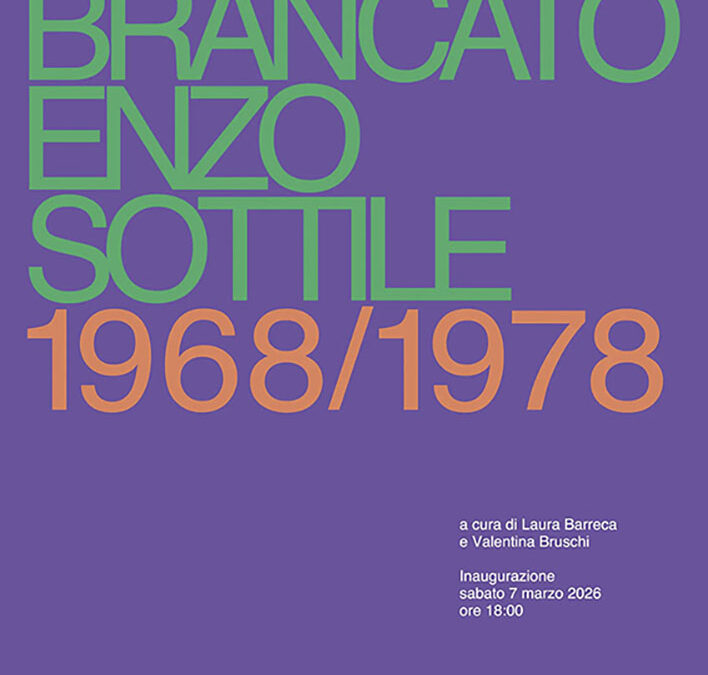
SARO BRANCATO – ENZO SOTTILE 1968–1978 curated by Laura Barreca and Valentina Bruschi with Angela Sottile
7 March – 10 May 2026 Saturday 7 March 2026, at 6.00 pm, the Castelbuono Civic Museum will open the joint exhibition by Saro Brancato and Enzo Sottile, dedicated to a crucial decade in their artistic development and research: the years between 1968 and 1978. The exhibition, curated by Laura Barreca and Valentina Bruschi, with scientific consultancy by Angela Sottile, stems from a desire to reinterpret that early shared period – between Castelbuono and Milan – as a watershed not only in biographical terms but also historically, politically and culturally.
The project presents the story of a moment in which generational imperatives, social tensions and the desire for experimentation found, even in a small town in the Sicilian hinterland, a surprising capacity for openness and dialogue with what was happening at national and international levels. When, between 1967 and 1968, Saro Brancato and Enzo Sottile began working together in Castelbuono, they were little more than teenagers. The shared studio near Piazza Margherita became a place for daily exchange, for the circulation of images and magazines, for listening to music and political discussion. In that climate, marked in Italy and across the world by student protests, social unrest and the musical revolution, art emerged as a necessary practice, a space of freedom and, at the same time, of responsibility. x
The historic ‘Rassegna ’70’ – held in Castelbuono and partially reconstructed in the exhibition through works, photographs and documents – marked the first public manifestation of that collective experience: an episode that formed part of a dialogue between the centre and the periphery within the context of the cultural ferment of those years. The exhibition presents around thirty significant works from the period 1968–1978, accompanied by documentary materials, photographs, posters and other archival items that evoke the atmosphere of that decade, revealing not only the evolution of artistic languages but also the relational and cultural fabric within which they took shape. Stylistically, the exhibition highlights some significant differences from the very outset: for Saro Brancato, a phase of informal abstraction in which the expressiveness of the gesture is contained within a rational geometric structure, followed by an engagement with the image and the pop aesthetic; for Enzo Sottile, a dialogue with the pop imagination expressed in a more intimate dimension, alongside photographic experiments and a growing focus on light and space as constitutive elements of his practice. Focusing on those years also means re-examining a decisive phase for Castelbuono.
Between the late 1960s and early 1970s, the town experienced a period of intense political and cultural engagement: associations were formed, opportunities for debate arose, and initiatives for preservation and experimentation took place, all of which have left a lasting legacy. Openness to the outside world, an interest in music, theatre and the visual arts, and dialogue with national and international contexts were not isolated episodes, but seeds that continue to sprout and which still contribute today to making Castelbuono a culturally vibrant centre.
The exhibition project is accompanied by a publication that expands upon and explores the exhibition’s narrative in greater depth. The volume includes a critical essay by Laura Barreca, an interview with the artists by Valentina Bruschi, a text by Saro Brancato dedicated to Enzo Sottile, an interview with Saro Brancato by Laura Slener, a contribution by Annamaria Guzzio on the Gruppo T theatre experimental group in Castelbuono, and two comprehensive biographies of the artists, accompanied by images documenting a broader body of work than the decade analysed in the exhibition.
The catalogue will be presented during a public event to be held during the exhibition period; the date and details of the event will be announced following the opening.
Artists’ biographies
Saro Brancato (Castelbuono, 1951) moved to Milan, where he attended the Brera Academy of Fine Arts under Domenico Cantatore and Gottardo Ortelli. In 1970, he took part in the “Rassegna ’70” in Castelbuono. Between 1974 and 1976, he worked as a freelance illustrator for Mondadori on the magazines Panorama and Due più. In the early 1980s, he began teaching art in state schools and developed a pictorial style based on large, flat areas of colour, often organised by the horizon line. In the 1990s, he began creating black-and-white series and subsequently produced “textile paintings”, in which pigment is replaced by fabrics, sometimes shaped into spiral forms described as “baroque”. Since 2010, he has moved towards a New Pop-inspired figurative style, and from 2020 he has permanently incorporated digital technology into his creative process. He has exhibited in solo and group exhibitions in Italy and abroad.
Enzo Sottile (Castelbuono, 1952). Following his early experiences within the Gruppo Uno, he took part in the “Rassegna ’70” in 1970. In 1971, he enrolled at the Brera Academy of Fine Arts in Milan, choosing Set Design and collaborating on theatrical productions, including for La Scala and the Piccolo Teatro. In 1973, he founded Gruppo T in Castelbuono, an experimental theatre company active for over thirty years. Having returned permanently to Sicily in 1975, he began working as a restorer of cultural heritage, collaborating with Sicilian heritage authorities, museums and dioceses. Between 2003 and 2008, he was director of the Castelbuono Civic Museum, for which he curated and designed the exhibition layout. At the same time, he developed a body of work that, starting from early pop-art-style graphite drawings and photographic experiments, shifted towards pieces centred on the themes of light, memory and the transformation of matter.
Public opening: Saturday 7 March 2026 at 6.00 pm
Duration of the exhibition: until 10 May 2026.
Address: Castello dei Ventimiglia, Piazza Castello, Castelbuono (Palermo)
Info: +39.0921671211 www.museocivico.eu
During March, the museum operates on its winter opening hours and is open daily from 9.30 am to 4.45 pm (last admission 15 minutes before closing time)
Summer opening hours will then come into effect from April, with the museum open daily from 9.30 am to 1.30 pm and 3.30 pm to 6.30 pm (last admission 15 minutes before closing time). These times are subject to change; please check the website.
Museum admission: full price €6.00, concessions €4.00, free under current agreements.